Call for proposals 2023
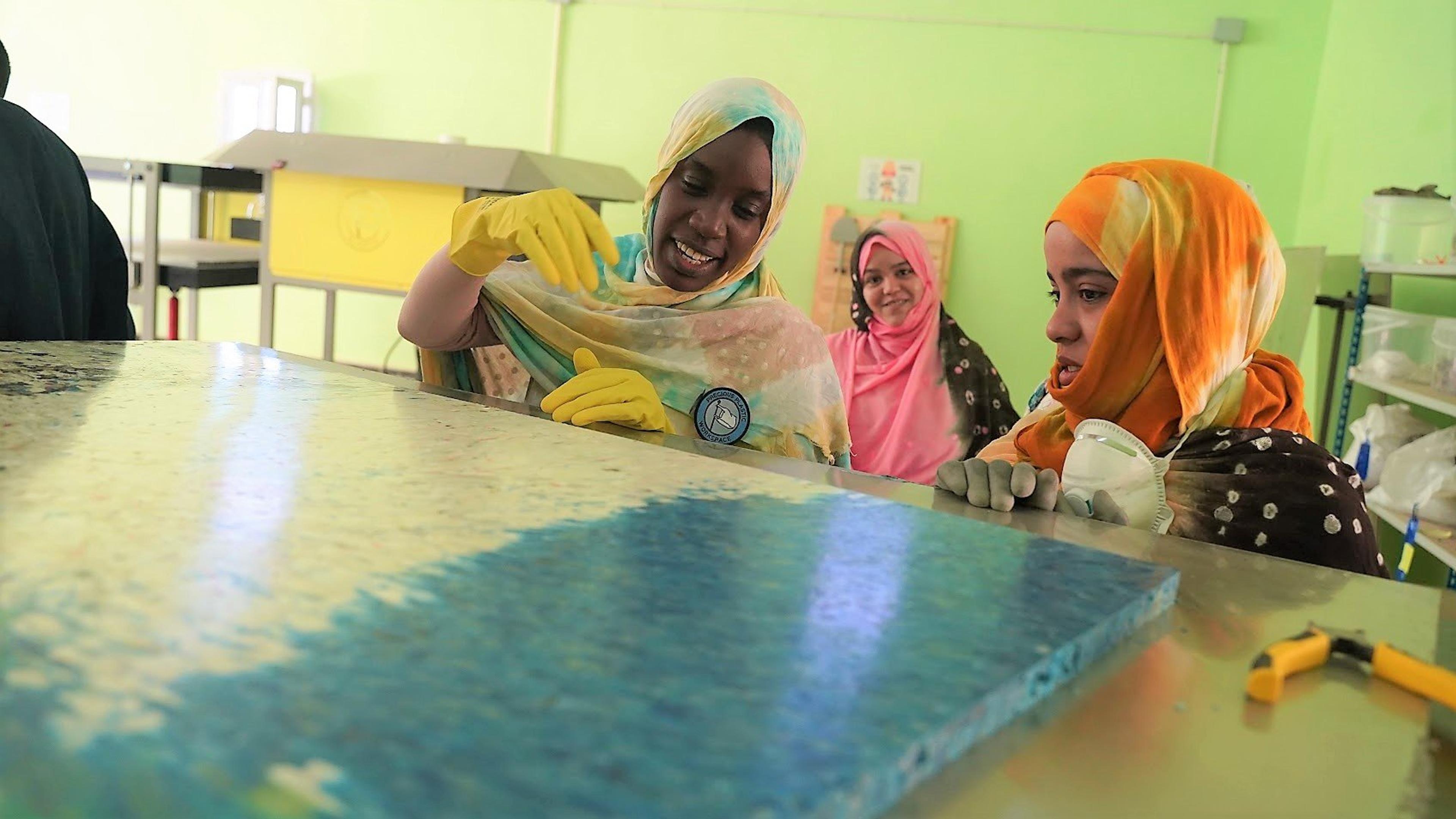 © Megan Lee
We support innovation projects led by humanitarian organisations where the expertise and technical know-how from the private sector has a role in solving humanitarian challenges. HIP Norway supports both early-stage innovation (Innovation Lab) and scaling of solutions that have proven to be successful at the pilot stage (Scaling grant scheme). Please see the requirements for both grant schemes at the bottom of the page. NB: The application form will open in April. In the meantime, you will find information about what to prepare under the information tab under each grant scheme.
Objectives and target group for the programme
HIP Norway is a grant and support mechanism, financed by the Norwegian Ministry of Foreign Affairs and administered by Innovation Norway.
HIP Norway aims to strengthen efforts to:
- Save lives, alleviate distress and safeguard human dignity in humanitarian crises.
- Provide people in need with the necessary protection and assistance in line with humanitarian principles.
To contribute to achieving the overall goal, HIP Norway will support projects that develop and scale innovative solutions that will contribute to smarter, better, more sustainable, and cost-effective emergency aid.
The target group(s) for the projects supported through the programme are people affected by humanitarian crises.
Overall, HIP Norway is evaluated based on the number of innovation partnerships established, the number of new solutions developed, successful pilots in humanitarian contexts, new innovative solutions being used that have a direct impact on end users, the number of solutions that have contributed to smarter, better, more sustainable and/or more cost-efficient response, and the number of innovations that have been scaled up in a humanitarian context.
Who can apply?
- UN agencies with a humanitarian mandate
- Norwegian humanitarian organisations with an international mandate (The organisation must be registered at the Brønnøysund Register and have both an office in Norway and a Norwegian board)
- Consortiums of multiple humanitarian organisations. In such collaborations, the main applicant has to come from category 1 or 2, and the other organisations can either come from these categories, or not, e.g., national NGOs etc.
We encourage humanitarian organisations to collaborate on joint applications.
HIP Norway mobilises and supports humanitarian-private partnerships. The humanitarian organisation/agency is the applicant and receiver of the grant.
Focus areas
HIP Norway is looking for bold ideas that seek to improve resilience against natural disasters or improve humanitarian response in conflicts and disasters. The programme supports projects within one or more of the following focus areas:
- Green humanitarian response: Efforts that contribute to more sustainable and environmentally friendly solutions within the humanitarian sector.
- Health and sanitation: Efforts to ensure lifesaving health services and the provision of facilities and services for the maintenance of hygienic conditions and the safe disposal of human waste.
- Protection: Efforts that contribute to protecting people from violence, abuse and violation of international law due to humanitarian crises. Applications focusing on protection from sexual and gender-based violence and children in armed conflict are encouraged.
- Innovative financing: Innovative financing refers to a number of non-traditional mechanisms for raising additional funds for humanitarian and development assistance. This may be through innovations such as micro-contributions, impact bonds, public-private partnerships and market-based approaches/ business models.
Call for proposals 2023
NOK 97 million is allocated to new Innovation Lab and scaling projects in 2023.
- Applications to the Innovation Lab scheme may range from NOK 4-6 million (or up to NOK 8 million for multiagency projects with three or more partnering organisations)
- Applications to the Scaling grant scheme may range from NOK 2-10 million
The total funding allocated for each grant scheme is subject to applications received.
Call timeline and process
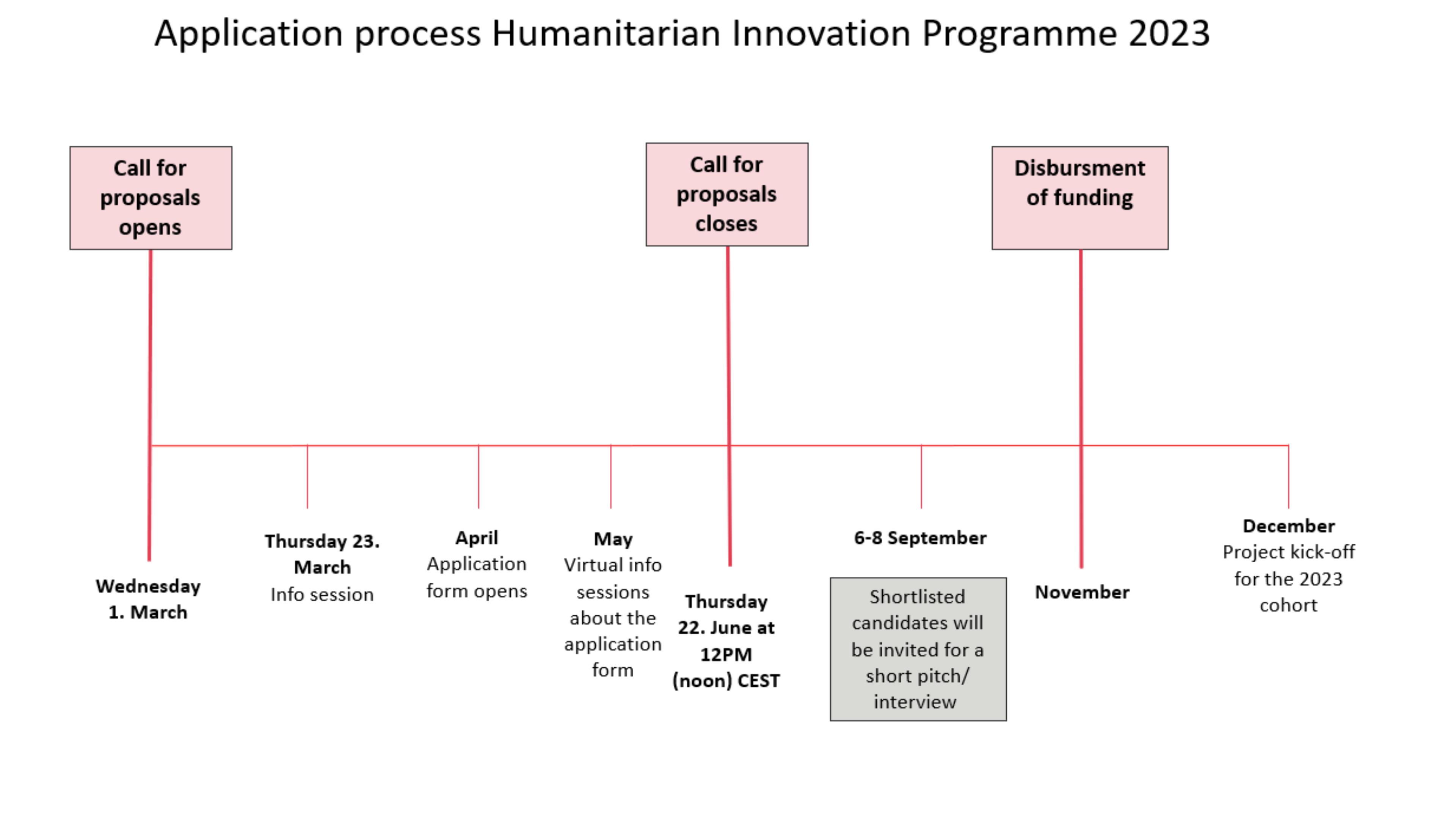
The application deadline is 22. June 2023, 12PM CEST (Noon).
Shortlisted projects will be invited to a 20-minute digital pitch/interview in front of an Innovation Norway panel on one of the following dates: 6., 7., or 8. September 2023. All applicants are encouraged to mark these dates in their calendars. The pitch/interview will consist of 10 minutes to answer 3-5 questions about the project received in advance, and 10 minutes for follow-up questions from the panel. We ask that relevant leadership is represented at the pitch; head of department/ section/ country office or similar.
- Innovative: The projects shall aim for transformational impact, bettering the lives of people affected by conflict and disasters, develop more sustainable solutions and/or contribute to more cost-efficient utilization of humanitarian funds. Projects with a high level of innovation will be prioritised.
- Humanitarian-private partnerships: The applicant must describe how the private sector is contributing, or will contribute, to the project.
- Impact and inclusivity: The projects shall impact people affected by conflict and natural disasters. The applicant must describe the expected involvement of affected people in the innovation process and how they may be impacted by the outcome.
- Scalable solutions: The projects shall aim for scaling, which refers to the process of replicating and/or adapting an innovation across large populations and geographies for transformational impact.
- Leadership commitment: The projects must ensure leadership commitment and sufficient resource allocation within the organisation(s).
- Sustainability: The projects will be considered across the three dimensions of sustainability; social, environmental and economic effect, as well as the handling of risks related to cross cutting issues; including human rights, gender equality, anti-corruption, climate and the environment.
- Humanitarian principles: The projects shall be conducted in accordance with the humanitarian principles; humanity, neutrality, impartiality and independency.
- Knowledge transfer: The projects must conduct and take part in activities for the sharing of knowledge with other organisations that engage in humanitarian response to ensure broader learning outcomes for the sector.
- Sourcing of products and solutions: The projects must ensure a transparent and competitive procurement process.
- Project length: The projects’ maximum length is two years from when the grant letter is signed.
- Reporting: All grant recipients are required to present Innovation Norway with a financial and narrative report on how the funds have been spent and the results of the project within two months after the project is completed. The narrative report may be in the organisation’s own reporting template and must include the topics listed in HIP Norway’s narrative report overview. Organisations may use their own template for financial reporting.
- Monitoring, Evaluation and Learning (MEL): The grant recipient is responsible for monitoring and reviewing the project, including conducting an evaluation of the solutions and the results. The projects may use their own MEL framework and include mandatory indicators from the HIP indicator menu, as well as the other relevant impact indicators included in the menu. All HIP projects must also complete a self-assessment (Emergent outcomes survey) after project completion. The emergent outcomes survey is to self-assess the impact of the innovation process.
- Project advisory groups: In order to lessen the burden of reporting, provide support and ensure progress in the projects, Innovation Norway will take part in the projects’ advisory groups.
- Surveys: Surveys are conducted on a regular basis to evaluate Innovation Norway. The grant recipient is expected to answer any such survey initiated by Innovation Norway or by any Norwegian Ministry.
- Contract: Applicants should note that the award of funding is conditional upon the ability to enter into and sign the grant agreement. Organizations that are unable, for any reason, to sign the contract within the required timeframe are kindly asked not to apply. Click here to download the standard agreement for innovation lab projects and for scaling projects.
The Innovation Lab supports early-stage innovation projects. The funding is milestone-based with two phases:
- Phase 1 is 30% of the total grant and is disbursed as the project signs with Innovation Norway.
- Phase 2 is 70% of the grant and will be disbursed once an innovation-friendly procurement has been conducted and an agreement with a private sector partner has been signed.
Process and milestones
The Innovation Lab grant scheme requires humanitarian organisations to employ the framework of innovation-friendly procurement. Innovation Norway will provide guidance and workshops to support this process. The milestones that grant recipients will need to conduct as part of the Innovation Lab are:
- Needs assessment: gaining a thorough understanding of the humanitarian challenge the project is seeking to address, including engagement of affected people.
- Market dialogue: an open dialogue with innovators and companies for inputs and discussions on approach and technology: does a suitable solution already exist? Or is there a need to develop something new?
- Performance-based specifications: informed by the needs assessment and market dialogue, an open, innovative and competitive procurement process should ask for function and performance rather than describing a final solution in detail. It should be open enough to allow for new and potentially unknown solutions to address the problem at hand.
Development / procurement: a formal process resulting in a development partnership with a private partner or procurement of an innovation / new solution.
Project costs
The grant can cover up to 100% of approved project costs.
- Purchasing of defined deliverables from private sector engagement, including material and technology investment in prototypes for piloting purposes
- Up to 30% of total innovation project costs for personnel dedicated to the project (including external consultants working as core project team members)
- Other expenses related to conducting the needs assessment, market dialogue and field testing, e.g. travel cost and training
- Indirect administration costs. This is stipulated in the organisation’s framework agreement with the Norwegian Ministry of Foreign Affairs or agreed by UN member states and usually equals 7 or 8% of the total grant. This must be included in the proposed budget.
Mandatory attachments to the application
- Monitoring, Evaluation and Learning framework. The projects may use their own MEL framework. The framework must include the mandatory indicators from the HIP indicator menu, as well as the other relevant impact indicators included in the menu. All HIP projects must also complete a self-assessment (Emergent outcomes survey) after project completion. The emergent outcomes survey is to self-assess the impact of the innovation process.
The Scaling grant scheme supports the uptake and scaling of solutions that have been successfully piloted and reached proof of concept in at least one humanitarian setting. Projects that have previously received support through the Innovation Lab will have an advantage in the competition for the Scaling grant scheme.
The Scaling grant scheme funds projects in two phases:
- Transition to scale focuses on the implementation of an innovative solution and the development and testing of different routes to scale. This opportunity is for projects that are rigging their innovations for scale in the very near future. Projects are expected to use this phase to demonstrate readiness for scaling by clarifying how the solution can be replicated and adapted, whether users and partners are ready to adopt it, and whether the necessary operational, financial, and organizational structures are in place to support growth.
- Scaling Impact focuses on turning readiness into actual, sustained scale. Projects are expected to implement the scaling strategy, secure concrete adoption decisions, support successful roll‑out in new contexts, and ensure the solution becomes embedded in systems, practices, or markets, with continuous learning and improvement to increase impact over time.
Projects can receive funding from the scaling grant twice, first for Transitioning to scale (typically a smaller grant) and then for Scaling Impact. The proposal will be evaluated on whether the budget applied for aligns with the plans and ambitions for the project in a given phase of scaling.
You can read more about the different phases of scaling in the HIP Scaling Framework – Scaled Impact.
Financing: Matching with private capital
The funding granted from HIP Norway must be matched 1-1 with private capital. The private capital must originate from private sources and be directly allocated to the project. Sources that qualify as private capital are investment funds, philanthropic funding, shareholders within the private company partner(s), loans, in-kind contributions etc.
The objective of public-private matching of funds is to increase overall funding to the innovation, and explore further innovative financing mechanisms within the humanitarian sector.
The grant and match funding shall cover costs related to scaling of the solution, including procurement and/or implementation of the solution, as well as testing of route(s) to scale in search of a viable and sustainable scaling model.
Project costs
Project costs that can be covered by the grant:
- Costs related to the procurement of the innovative solution.
- Costs related to implementation and diffusion (such as travel costs, capacity building of staff and affected people).
- Up to 30% of total innovation project costs for personnel dedicated to the project (included external consultants working as core project team members).
- Indirect administration costs. This is stipulated in the organisation’s framework agreement with the Norwegian Ministry of Foreign Affairs or agreed by UN member states and usually equals 7 or 8% of the total grant. This must be included in the proposed budget.
Mandatory attachments to the application
- Evidence of proof of concept: please attach documents that provide information of the proof of concept and results from pilot testing.
- Scaling plan: The scaling plan should define potential route(s) to scale that will be explored during the project period. The scaling plan should also include:
- Value creation model(s) that will be tested, in search of long-term sustainability of the solution, such as; a business model, livelihood models, circular economy or other.
- Identification of risk and risk management e.g. relevant regulations, other barriers to scale.
- An overview of the roles various actors will play in scaling the solution. Read more about the five essential roles for scaling in the HIP Scaling Framework.
- Partnership agreement: A partnership agreement between the humanitarian organisation and private companies must be signed and attached to the application. The agreement should include relevant information such as distribution of IPR, costs and income.
- Monitoring, Evaluation and Learning framework: The projects may use their own MEL framework. The framework must include the mandatory indicators from the HIP indicator menu, as well as the other relevant impact indicators included in the menu. All HIP projects must also complete a self-assessment (Emergent outcomes survey) after project completion. The emergent outcomes survey is to self-assess the impact of the innovation process.
- Confirmation of 1-1 matched private funding.
A PDF version of the call can be downloaded here.
A word version of the application form can be downloaded here: Innovation Lab grant application form , Scaling grant application form.
For questions, read up on FAQs or contact one of our advisors.